The Book in 3 Sentences
- The supreme art of war is to win without fighting, wherein battle, if it happens at all, is already decided before it begins.
- Victory comes from knowing yourself and knowing your enemy, from adapting like water to the shape of the ground, and from striking where the opponent is unprepared rather than where he is strong.
- Written as thirteen short chapters of maxims on strategy, terrain, spies and the use of energy, its lessons apply as much to business, negotiation and personal conflict as to the battlefield.
Overview & Impressions
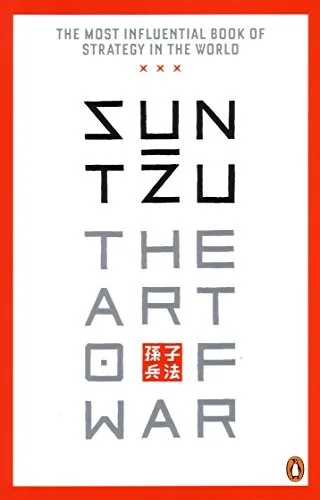
I found The Art of War to be a simple, intuitive and clean read. It is very short and easy to follow, and much of the text is principles of strategy and tactics that can be applied across all sorts of areas of life. I appreciated the somewhat random war-specific guidance, as the details around provisions, terrain and the like added some spice to the piece rather than leaving it as pure abstraction. I picked up the Penguin edition in the Sydney domestic terminal on the way to Melbourne. Well worth a couple of hours.
Top Quotes
Supreme excellence consists in breaking the enemy’s resistance without fighting.
If you know the enemy and know yourself, you need not fear the result of a hundred battles.
The victorious strategist only seeks battle after the victory has been won, whereas he who is destined to defeat first fights and afterwards looks for victory.
Summary, Quotes & Notes
I Laying Plans
The art of war is of vital importance to the State. It is a matter of life and death, a road either to safety or to ruin. Hence it is a subject of inquiry which can on no account be neglected.
All warfare is based on deception.
Hence, when able to attack, we must seem unable; when using our forces, we must seem inactive; when we are near, we must make the enemy believe we are far away; when far away, we must make him believe we are near.
Attack him where he is unprepared, appear where you are not expected.
Now the general who wins a battle makes many calculations in his temple ere the battle is fought. The general who loses a battle makes but few calculations beforehand.
II Waging War
In war, then, let your great object be victory, not lengthy campaigns.
There is no instance of a country having benefited from prolonged warfare.
Bring war material with you from home, but forage on the enemy. Thus the army will have food enough for its needs.
Hence a wise general makes a point of foraging on the enemy. One cartload of the enemy’s provisions is equivalent to twenty of one’s own.
III Attack by Stratagem
Hence to fight and conquer in all your battles is not supreme excellence; supreme excellence consists in breaking the enemy’s resistance without fighting.
Thus the highest form of generalship is to balk the enemy’s plans; the next best is to prevent the junction of the enemy’s forces; the next in order is to attack the enemy’s army in the field; and the worst policy of all is to besiege walled cities.
He will win who knows when to fight and when not to fight.
If you know the enemy and know yourself, you need not fear the result of a hundred battles. If you know yourself but not the enemy, for every victory gained you will also suffer a defeat. If you know neither the enemy nor yourself, you will succumb in every battle.
IV Tactical Dispositions
The good fighters of old first put themselves beyond the possibility of defeat, and then waited for an opportunity of defeating the enemy.
To secure ourselves against defeat lies in our own hands, but the opportunity of defeating the enemy is provided by the enemy himself.
Thus it is that in war the victorious strategist only seeks battle after the victory has been won, whereas he who is destined to defeat first fights and afterwards looks for victory.
V Energy
In battle, there are not more than two methods of attack - the direct and the indirect; yet these two in combination give rise to an endless series of manoeuvres.
There are not more than five musical notes, yet the combinations of these five give rise to more melodies than can ever be heard.
The quality of decision is like the well-timed swoop of a falcon which enables it to strike and destroy its victim.
VI Weak Points and Strong
Whoever is first in the field and awaits the coming of the enemy, will be fresh for the fight; whoever is second in the field and has to hasten to battle will arrive exhausted.
Military tactics are like unto water; for water in its natural course runs away from high places and hastens downwards. So in war, the way is to avoid what is strong and to strike at what is weak.
Water shapes its course according to the nature of the ground over which it flows; the soldier works out his victory in relation to the foe whom he is facing.
Therefore, just as water retains no constant shape, so in warfare there are no constant conditions.
VII Manoeuvring
Let your rapidity be that of the wind, your compactness that of the forest. In raiding and plundering be like fire, in immovability like a mountain.
Let your plans be dark and impenetrable as night, and when you move, fall like a thunderbolt.
When you surround an army, leave an outlet free. Do not press a desperate foe too hard.
VIII Variation in Tactics
There are roads which must not be followed, armies which must not be attacked, towns which must not be besieged, positions which must not be contested, commands of the sovereign which must not be obeyed.
The art of war teaches us to rely not on the likelihood of the enemy’s not coming, but on our own readiness to receive him; not on the chance of his not attacking, but rather on the fact that we have made our position unassailable.
IX The Army on the March
Humble words and increased preparations are signs that the enemy is about to advance.
When the soldiers stand leaning on their spears, they are faint from want of food.
If soldiers are punished before they have grown attached to you, they will not prove submissive; and, unless submissive, then will be practically useless.
X Terrain
The natural formation of the country is the soldier’s best ally.
The general who advances without coveting fame and retreats without fearing disgrace, whose only thought is to protect his country and do good service for his sovereign, is the jewel of the kingdom.
Regard your soldiers as your children, and they will follow you into the deepest valleys; look upon them as your own beloved sons, and they will stand by you even unto death.
XI The Nine Situations
Rapidity is the essence of war: take advantage of the enemy’s unreadiness, make your way by unexpected routes, and attack unguarded spots.
Throw your soldiers into positions whence there is no escape, and they will prefer death to flight.
At first, then, exhibit the coyness of a maiden, until the enemy gives you an opening; afterwards emulate the rapidity of a running hare, and it will be too late for the enemy to oppose you.
XII The Attack by Fire
Move not unless you see an advantage; use not your troops unless there is something to be gained; fight not unless the position is critical.
No ruler should put troops into the field merely to gratify his own spleen; no general should fight a battle simply out of pique.
Anger may in time change to gladness; vexation may be succeeded by content. But a kingdom that has once been destroyed can never come again into being; nor can the dead ever be brought back to life.
XIII The Use of Spies
What enables the wise sovereign and the good general to strike and conquer, and achieve things beyond the reach of ordinary men, is foreknowledge.
Now this foreknowledge cannot be elicited from spirits; it cannot be obtained inductively from experience, nor by any deductive calculation. Knowledge of the enemy’s dispositions can only be obtained from other men.