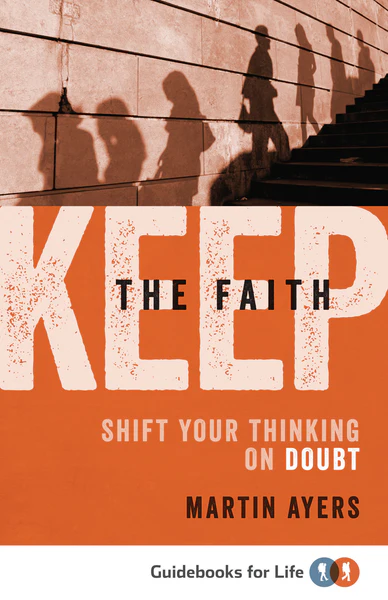
The Book in 3 Sentences
- Part 1 challenges the myth of neutrality, arguing that our minds filter facts based on our heart's desires and prior commitments; therefore, we must judge worldviews not by whether they are "unbiased" (none are), but by their internal consistency and coherence with reality.
- Part 2 provides practical tactics for persevering, such as "doubting your doubts" by subjecting alternative beliefs to the same scrutiny as Christianity and recognising that intellectual struggles often stem from spiritual drift or idolatry.
- The ultimate antidote to doubt is not just reading apologetics, but actively living out the faith - fully investing in the Christian life, nurturing affection for Jesus through spiritual disciplines, and trusting that God is the one who ultimately sustains our faith.
Overview & Impressions
I found Keep the Faith to be a thorough and intellectually honest guide to dealing with doubt. It manages to be theologically rich without being dense, making it a nice, short read anyone could get through in a couple of days. Ayers refuses to treat atheism as a neutral default, challenging the reader to see that everyone, whether Christian or not, wears interpretative glasses. The book is encouraging because it normalises doubt as part of the human experience, yet challenging in that it demands we examine the hidden idols or prior commitments that often drive those doubts. It shifts the battleground from purely intellectual arguments to the posture of the heart, which I think is a helpful and practical perspective.
Top Quotes
The point is not that Christians are unbiased but that everyone is biased and there is no neutral ground.
Doubt your doubts... What is the alternative position? And why would you believe that alternative over the bible?
Faith is about trusting something and can result from following evidence to where it leads and acting upon it.
The most loving thing Jesus could do was let him [Lazarus] die and raise him to life so that he could believe in Jesus.
Summary, Quotes & Notes
I Shift the way you think
God says the truth about him is plain from looking at creation. The world around us declares his glory.
It sounds offensive to accuse all of the otherwise-very-reasonable people around us who don’t believe in God of deliberately putting a spin on the evidence that God is there so that they don’t have to answer to him.
Our minds filter facts in an attempt to make sense of what we’re seeing based on what we believe about the world around us.
Arguments that bash God often reveal prejudice. You hate God, and the bible warns that if you hate him you will always find ways to suppress the truth about him.
We need to deconstruct our assumption that atheism is the default position/neutral ground.
Faith is about trusting something and can result from following evidence to where it leads and acting upon it. It is not blind and based off just feelings.
Once you make a prior commitment, you see everything through that lens.
Believing only what you can prove is not itself based on logical deduction or scientific experiment.
As Christian’s believe we have a God-given ability to use our mind to understand God’s world.
The Christian faith is not based on reason or science, it is based on revelation.
The only way we can get to truth is through God’s revelation to us. Matt 11:27
No experiment can lead us to know God.
If you’ve made a prior commitment that you can only know things using your powers of deduction and observation, you’ve already ruled out the possibility that a book which claims to reveal truth to you can be true.
God is beyond our fallen, limited reasoning.
People do not want to believe in God so they are attracted to belief systems that rule out his existence.
Christians are interpreting the world through their own lenses as much as non-Christians.
“maybe Christians are so desperate to find morality and purpose in their lives that they interpret the world in this way”
The point is not that Christians are unbiased but that everyone is biased and there is no neutral ground.
What you believe has such a big impact on your life that its impossible to be objective.
The desires we have in our hearts affect the conclusions we draw in our minds.
If we can’t be neutral about this, what can we do?
- Check the beliefs for internal consistency.
The bible gives us an explanation of God, ourselves and the world which is perfectly consistent throughout.
- We can check for coherence (with the world around us).
The bible’s truths about humanity and the world make sense of everything, transcending every culture across time.
The more you know the bible the more difficult it is to deny this.
Even with such a strong desire otherwise, there can come a point where the evidence contrary is so overpowering that we cannot ignore it.
The fact that somebody has changed their view does not mean that they have found the right answer. They may be ill informed.
C.S. Lewis → the most dejected and reluctant convert in all of England.
The bible tells us that no Christian deserves any credit for coming to trust in the truth of Christ.
All of us have friends, family etc. who are not Christians but are kind, intelligent, loving people.
The bible declares that every human is equally valuable and enormously precious in God’s sight because he made each person in his image.
Humanism → God is not there and humanity still matters.
If we are just collections of atoms thrown together by physical forces, then it’s ridiculous to talk about right and wrong. Genocides just happen, like solar eclipses.
Peter Singer → we need to stop assuming that humans have rights simply by virtue of being human. This ‘speciesism’ is no better than racism.
The philosophers of today have a profound impact on the politicians of tomorrow.
The bible balances healthy realism with a radical positivity about humanity.
Without Christ’s redemption, we simply can’t think straight any more.
II Shift the way you act
It’s not easy to keep going when your reasonable, intelligent, successful friends think you’ve gone mad.
God’s word can help us in these situations because it reminds us that its not simply an intellectual battle.
We can’t expect reading a book like this to vanquish our doubts forever.
It can be an encouragement that we’ll have doubts no matter what we believe.
IF you are reading this book and have been struggling with doubt for some time, you perhaps have already found some disciplines or experiences that help you. You might find that reading books that reassure you about the historical reliability of the bible, or the evidence for the resurrection, or the scientific and philosophical arguments for the existence of God, encourage you.
Or perhaps this may come through a personal experience.
When you’re struggling to keep the faith, remember the Fall, remember your redeemer and remember the stakes.
We have God’s revelatory word so that we can know everything we need to know to be saved.
Expect opposition, expect that whatever persuaded you to be a Christian may well not persuade others, because we’re all wearing glasses that distort our vision and render a fair trial impossible.
Doubt your doubts.
What is the alternative position? and why would you believe that alternative over the bible? Would God need to be a different kind of God for you doubt to be valid? What would that version of God be like? Why would you believe in that God? And would you really want to place your life in the hands of that God? What has become your authority? is it internally consistent? Does it really make better sense of the world than the Bible does? What do you doubt about your new authority?
Turn your doubts into alternate positions of faith and subject them to the same level of scrutiny as your Christian faith.
Differing biblical accounts can both be true if you think about it a bit.
The Fall should remind us to leap into God’s word instead of leaping to conclusions based on our own ideas.
Keeping clear the reasons why we’ve put our trust in Jesus in our minds will help us to keep the faith.
A lot of clever, inventive people are trying to raise arguments against the bible.
If you don’t have an answer to an arguments, don’t panic. It is most likely centuries old.
Christianity has been weighed and measured throughout history, again and again, and it has never been found wanting.
One way to help yourself is to remind yourself of the fundamentals.
Teach the Christian faith to children. It forces you to work hard on the basics.
You can also attend a beginners Christianity course at Church.
Because faith/doubts are spiritual/moral issues, doubt should drive us to get stuck in to the Christian life.
Sometimes we feel 95% sure and other times 55%, causing us to draw back and stop living for Christ as wholeheartedly. This tactic is disastrous because Christ calls us to worship him with our whole lives.
Following Jesus is an all or nothing experience and its as you go for it with your whole life that your conviction grows.
If you live out the Christian worldview in everything you do, develop your personal relationship wit Jesus, love him and serve him, you will seek the truth and your doubts will dissipate.
When struggling with doubt its important to seek help from Christians you trust.
While it can be tempting to think that the best solution is to read something ‘balanced’, or perhaps seek the help of a non-Christian who you think might be able to offer unbiased advice, that is faulty because, as we’ve seen, people are either for God or against him. There is no source for unbiased advice.
Older Christians consider it a privilege to come alongside others who are struggling.
Other people will have given the same doubts a lot of thought as well.
There are sure to be answers you haven’t heard, books you haven’t read , testimonies you haven’t heard.
Those who do persevere in their faith do so only because the father has drawn them and held them. Faith is a gift from God.
When we have doubts there are underlying reasons, whether we are conscious of them or not.
When we devote ourselves to something other than God, that idol will fill our hearts and inevitably our doubts about Christianity will grow.
Whether its money or sex or power etc. the more we daydream about it the further our hearts will drag our minds into wishful thinking in the opposite direction of the Christian faith.
Eg. feeling like Christianity is more of a burden than it used to be → intellectual doubts arise. Dating anon-Christian → doubts arising. Full sending career → pulling back on Church involvement etc.
We need to pray to God to reveal our idols to us because without this perspective we will never see them for what they are.
When we turn our hearts back to God and smash our idols we can correct our thinking and enjoy the experience of watching our doubts subside.
And so we need to renew our focus on our redeemer. This is counterintuitive. We are in the habit of thinking that our minds are genuinely neutral and objective and that we can weight up the evidence about Jesus in an unbiased way. If that were the case, then it might be best to deal with doubts by spending less time learning about Jesus in the bible and more time reading lengthy tomes on apologetics and polemics - both those supporting the Christian faith and those against it. Why waste your5 time thinking about Jesus when you’re not certain if he’s real? Why not take a step back instead, until you’ve decided the bigger question about whether his claims are actually true? As we’ve seen, this approach is flawed.
How we can most appropriat3ely spend more time focusing on our redeemer and nurturing our affectiuon for him will vary from person to person. It will certainly involve more time devoted to bible reading and prayer. But its also important to pursue the spiritual disciplines that you know will help you restore Jesus to the center of your life. Eg. listening to hymns, spending time with Christians, reading Christian biographies, bible studies, journaling, memorising scripture, silent reflection.
Jesus delays saving Lazarus to put it beyond doubt that he was dead. v6 it is out of love that Jesus does this because faith is so vital that the most loving thing Jesus could do was let him die and raise him to life so that he could believe in Jesus.
This is how seriously Jesus takes every opportunity to strengthen your trust in him.
If you gave up Christianity you’d only give it up to live for something else. Whatever that is, death would be the end of it. Nothing else has an answer to death.
The life that we’ll live forever with Jesus in the new creation has already begun, life knowing God, living for him and enjoying his blessings, if we trust in him as we live knowing him and becoming the people he made us to be.
Jesus is the resurrection and the life and he is also completely, amazingly compassionate.
Lazarus’ living, breathing presence in Bethany was an ongoing testimony to Jesus’ power.
Note that when John describes the reactions to this miracle, the divide is not between believers and non-believers but between those who put their trust in Jesus sand those who seek to work against him.
Everyone there excepted his signs as genuine, and yet there were those who were committed against him.
We can say therefore that the more we focus on Jesus, the more delighted we will be.
We need to hold two truths in tension: God is the giver of faith and he preserves people in their faith. Both those facts in no way diminish our own responsibility to keep leaning our weight on God’s promises - to persevere in trusting him.
A failure to grow and fully invest in the Christian life can be a symptom of somebody struggling with doubts.
Heb 6:4-6 → People who cannot be restored to repentance: they have once been enlightened, they have tasted the heavenly gift, they have shared in the holy spirit, and they have tasted both the goodness of the word of God and the powers of the age to come - and then they fell away. God will not grant them repentance because they bring shame upon Jesus and hold him to utter contempt.
It looks as though they were once Christians, but they were not.
We need to heed the warning of Heb 6 that for some of us, if we were to fall away now, there would be no way back.
Real faith, faith that lasts, is faith that produces good works.
Be reassured by these as signs that your faith is genuine, and take them to heart as your resolve to keep going.