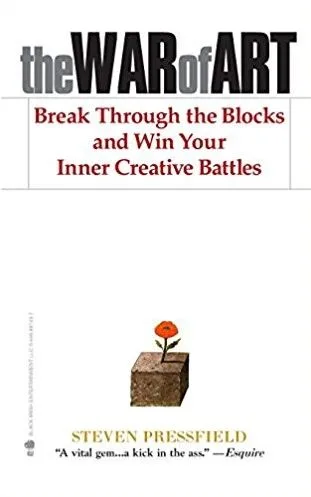
The Book in 3 Sentences
- Resistance is the invisible, universal force that stops us from doing our work and it shows up as procrastination, fear, self-doubt, rationalisation and a dozen other disguises, exactly where the work matters most.
- The only way past resistance is to turn pro: show up every day, treat your creative work like a job regardless of how you feel and measure yourself by whether you did the work rather than by the result.
- The artist must work for the love of the work itself and once you commit the Muse will come to your aid.
Overview & Impressions
The War of Art presents a refreshing take on creativity. Pressfield diagnoses Resistance as the main barrier between us and our work, and the book is instructive and practical about how to beat it. Its run-through of the many symptoms of Resistance is particularly helpful, since awareness already breaks down many creative barriers. I appreciated its treatment of creativity as a skill and a discipline rather than something that strikes when inspiration happens to arrive. It got a bit wishy-washy and spiritual near the end but overall this was a very good read.
Top Quotes
The more important a call or action is to our soul’s evolution, the more Resistance we will feel toward pursuing it.
He knows that by toiling beside the front door of technique, he leaves room for genius to enter by the back.
Of any activity you do, ask yourself: If I were the last person on earth, would I still do it?
Summary, Quotes & Notes
I
Rule of thumb: The more important a call or action is to our soul’s evolution, the more Resistance we will feel toward pursuing it.
It is a commonplace among artists and children at play that they’re not aware of time or solitude while they’re chasing their vision.
II
It is one thing to study war and another to live the warrior’s life. - Telamon of Arcadia, mercenary of the fifth century B. C.
If he caves in today, no matter how plausible the pretext, he’ll be twice as likely to cave in tomorrow.
The pro doesn’t even pick up the phone. He stays at work.
The field is level, the professional understands, only in heaven.
The professional is prepared at a deeper level. He is prepared, each day, to confront his own self-sabotage.
His goal is not victory (success will come by itself when it wants to) but to handle himself, his insides, as sturdily and steadily as he can.
His style serves the material. He does not impose it as a means of drawing attention to himself.
The professional respects his craft.
He knows that by toiling beside the front door of technique, he leaves room for genius to enter by the back.
It would never occur to him, as it would to an amateur, that he knows everything, or can figure everything out on his own.
He seeks out the most knowledgeable teacher and listens with both ears.
She does not identify with this instrument. It is simply what God gave her, what she has to work with.
Madonna does not identify with “Madonna.” Madonna employs “Madonna.”
The professional cannot take rejection personally because to do so reinforces Resistance.
The Bhagavad-Gita tells us we have a right only to our labor, not to the fruits of our labor.
The professional gives an ear to criticism, seeking to learn and grow. But she never forgets that Resistance is using criticism against her on a far more diabolical level.
The professional cannot let himself take humiliation personally.
He didn’t allow an act that by all rights should have provoked an automatic response of rage to actually produce that rage.
What he did do was maintain his sovereignty over the moment.
The professional cannot allow the actions of others to define his reality.
Resistance wants us to cede sovereignty to others.
The professional blows critics off. He doesn’t even hear them.
The critic hates most that which he would have done himself if he had had the guts.
She gets an agent, she gets a lawyer, she gets an accountant. She knows she can only be a professional at one thing. She brings in other pros and treats them with respect.
As artists we serve the Muse, and the Muse may have more than one job for us over our lifetime.
The professional does not permit himself to become hidebound within one incarnation, however comfortable or successful.
The professional senses who has served his time and who hasn’t.
Making yourself a corporation (or just thinking of yourself in that way) reinforces the idea of professionalism because it separates the artist-doing-the-work from the will-and-consciousness-running-the-show.
I have one of those meetings with myself every Monday. I sit down and go over my assignments. Then I type it up and distribute it to myself.
I have corporate stationery and corporate business cards and a corporate checkbook. I write off corporate expenses and pay corporate taxes. I have different credit cards for myself and my corporation.
Sometimes, as Joe Blow himself, I’m too mild-mannered to go out and sell. But as Joe Blow, Inc., I can pimp the hell out of myself.
Resistance has no strength of its own; its power derives entirely from our fear of it.
The ancient Spartans schooled themselves to regard the enemy, any enemy, as nameless and faceless.
There’s no mystery to turning pro. It’s a decision brought about by an act of will. We make up our minds to view ourselves as pros and we do it.
III
As Resistance works to keep us from becoming who we were born to be, equal and opposite powers are counterpoised against it. These are our allies and angels.
The most important thing about art is to work. Nothing else matters except sitting down every day and trying.
When we sit down day after day and keep grinding, something mysterious starts to happen. A process is set into motion by which, inevitably and infallibly, heaven comes to our aid. Unseen forces enlist in our cause; serendipity reinforces our purpose.
What I call Professionalism someone else might call the Artist’s Code or the Warrior’s Way. It’s an attitude of egolessness and service.
The Knights of the Round Table were chaste and self-effacing. Yet they dueled dragons.
The last thing I do before I sit down to work is say my prayer to the Muse. I say it out loud, in absolute earnest.
In my little house I had no TV. I never read a newspaper or went to a movie. I just worked.
I never did find a buyer for the book. Or the next one, either. It was ten years before I got the first check for something I had written and ten more before a novel, The Legend of Bagger Vance, was actually published.
Nobody knew I was done. Nobody cared. But I knew. I felt like a dragon I’d been fighting all my life had just dropped dead at my feet and gasped out its last sulfuric breath.
The Muses were nine sisters, daughters of Zeus and Mnemosyne, which means “memory.” Their names are Clio, Erato, Thalia, Terpsichore, Calliope, Polyhymnia, Euterpe, Melpomene, and Urania. Their job is to inspire artists. Each Muse is responsible for a different art.
But if a man comes to the door of poetry untouched by the madness of the Muses, believing that technique alone will make him a good poet, he and his sane compositions never reach perfection, but are utterly eclipsed by the performances of the inspired madman.
The contemporary view is that all this is charming but preposterous. Is it? Then answer this. Where did Hamlet come from? Where did the Parthenon come from?
I believe there are angels. They’re here, but we can’t see them.
When we make a beginning, we get out of our own way and allow the angels to come in and do their job.
I take a pocket tape recorder because I know that as my surface mind empties with the walk, another part of me will chime in and start talking.
What does it tell us about the architecture of our psyches that, without our exerting effort or even thinking about it, some voice in our head pipes up to counsel us (and counsel us wisely) on how to do our work and live our lives?
Chaos itself is self-organizing.
“Noncreative people” hate “creative people.” Because they’re jealous.
Nonsense. We’re all creative. We all have the same psyche.
The eagle was telling me that dreams, visions, meditations such as this very one - things that I had till now disdained as fantasy and illusion - were as real and as solid as anything in my waking life.
- The Ego believes that our existence is defined by our physical flesh.
- Time and space are real. The Ego is analog. It believes that to get from A to Z we have to pass through B, C, and D.
- The Ego believes that I am distinct from you.
- The predominant impulse of life is self-preservation.
- There is no God.
Here’s what the Self believes:
- Death is an illusion.
- Time and space are illusions.
- All beings are one.
- The supreme emotion is love.
- God is all there is.
Have you ever wondered why the slang terms for intoxication are so demolition-oriented? Stoned, smashed, hammered. It’s because they’re talking about the Ego.
We demolish the Ego to get to the Self.
Dreams come from the Self. Ideas come from the Self. When we meditate we access the Self. When we fast, when we pray, when we go on a vision quest, it’s the Self we’re seeking.
When we deliberately alter our consciousness in any way, we’re trying to find the Self.
The Self is our deepest being. The Self is united to God. The Self is incapable of falsehood. The Self, like the Divine Ground that permeates it, is ever-growing and ever-evolving. The Self speaks for the future. That’s why the Ego hates it.
The Ego doesn’t want us to evolve.
The instinct that pulls us toward art is the impulse to evolve, to learn, to heighten and elevate our consciousness.
Fear That We Will Succeed. That we can access the powers we secretly know we possess. That we can become the person we sense in our hearts we truly are. This is the most terrifying prospect a human being can face, because it ejects him at one go (he imagines) from all the tribal inclusions his psyche is wired for and has been for fifty million years.
We come into this world with a specific, personal destiny. We have a job to do, a calling to enact, a self to become. We are who we are from the cradle, and we’re stuck with it.
Our job in this lifetime is not to shape ourselves into some ideal we imagine we ought to be, but to find out who we already are and become it.
For the artist to define himself hierarchically is fatal.
- Compete against all others in the order.
- Evaluate his happiness/success/achievement by his rank within the hierarchy.
- Act toward others based upon their rank.
- Evaluate his every move solely by the effect it produces on others.
But the artist cannot look to others to validate his efforts or his calling. If you don’t believe me, ask Van Gogh, who produced masterpiece after masterpiece and never found a buyer in his whole life.
To labor in the arts for any reason other than love is prostitution.
In the hierarchy, the artist looks up and looks down. The one place he can’t look is that place he must: within.
He does not ask himself, What do I myself want to write? What do I think is important? Instead he asks, What’s hot, what can I make a deal for?
To my amazement, the book succeeded critically and commercially better than anything I’d ever done, and others since have been lucky too. Why? My best guess is this: I trusted what I wanted, not what I thought would work. I did what I myself thought was interesting, and left its reception to the gods.
- A territory provides sustenance.
- A territory sustains us without any external input.
- A territory can only be claimed alone.
- A territory can only be claimed by work.
- A territory returns exactly what you put in.
What’s your territory?
The artist and the mother are vehicles, not originators.
Of any activity you do, ask yourself: If I were the last person on earth, would I still do it?
Do it as an offering to God.
To labor in this way, The Bhagavad-Gita tells us, is a form of meditation and a supreme species of spiritual devotion.
Were you put on earth to be a painter, a scientist, an apostle of peace? In the end the question can only be answered by action.
Do it or don’t do it.