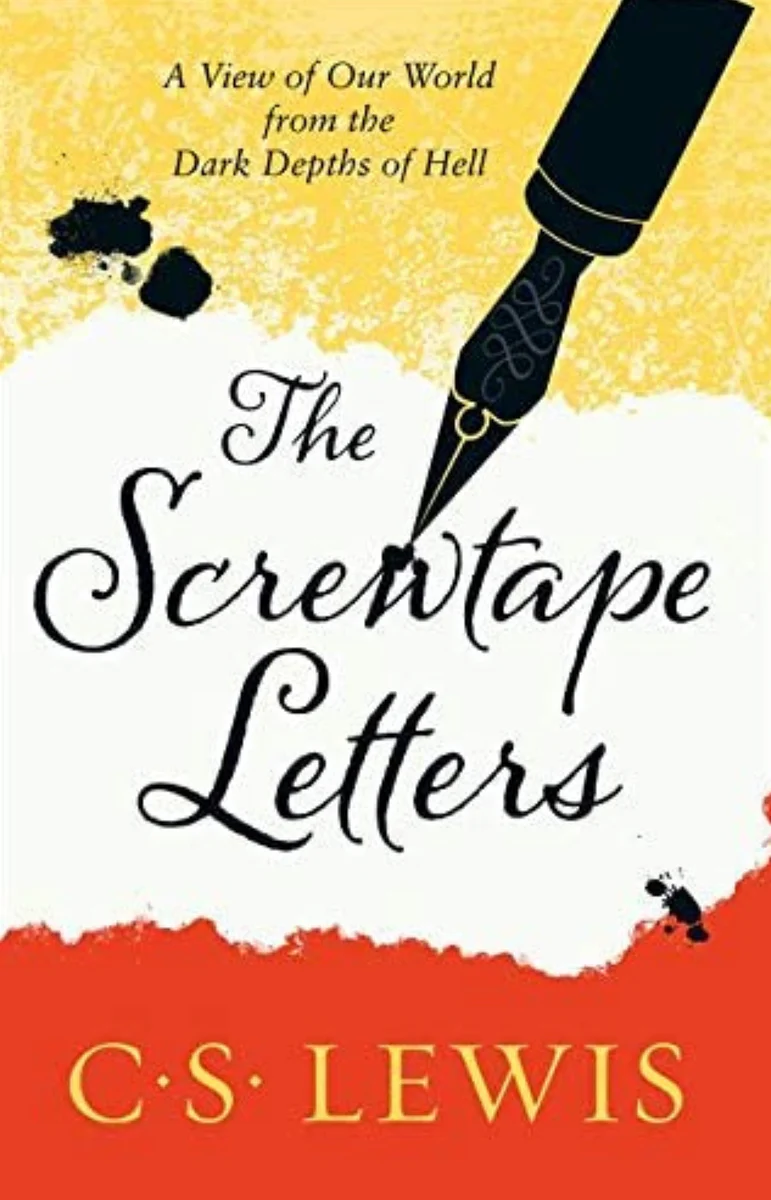
The Book in 3 Sentences
- The book uses a satirical correspondence between two demons to reveal that evil wins not through spectacular sins, but through the cumulative effect of small distractions, resentments and moderated religion that gently edge a person away from the Light.
- Lewis explores the human condition as one of peaks and troughs, arguing that while God wants humans to focus on the Present (where time touches eternity), the devil wants them anxious about the Future or obsessed with the Past.
- The ultimate spiritual trap is the sense of ownership - believing that our time, our bodies, and our lives are our own property - which prevents the surrender of self necessary for true freedom.
Overview & Impressions
I found The Screwtape Letters to be a nice, short read and insightful view into how the biblical devil operates. It’s an engaging account of human temptation, comedic in its satire of bureaucratic evil yet theologically deep and practical. It’s a strong reminder that the spiritual war is fought in the mundane moments of daily life.
Top Quotes
Indeed the safest road to Hell is the gradual one - the gentle slope, soft underfoot, without sudden turnings, without milestones, without signposts.
Our cause is never more in danger than when a human, no longer desiring, but still intending, to do our Enemy's will, looks round upon a universe from which every trace of Him seems to have vanished, and asks why he has been forsaken, and still obeys.
All mortals tend to turn into the thing they are pretending to be.
Summary, Quotes & Notes
It does not matter how small the sins are provided that their cumulative effect is to edge the man away from the Light and out into the Nothing. Murder is no better than cards if cards can do the trick.
Indeed the safest road to Hell is the gradual one--the gentle slope, soft underfoot, without sudden turnings, without milestones, without signposts
Whatever their bodies do affects their souls. It is funny how mortals always picture us as putting things into their minds: in reality our best work is done by keeping things out.
The more often he feels without acting, the less he will be able ever to act, and, in the long run, the less he will be able to feel.
Our cause is never more in danger than when a human, no longer desiring, but still intending, to do our Enemy's will, looks round upon a universe from which every trace of Him seems to have vanished, and asks why he has been forsaken, and still obeys.
Gratitude looks to the Past and love to the Present; fear, avarice, lust, and ambition look ahead. For the Present is the point at which time touches eternity.
The Future is, of all things, the thing least like eternity. It is the most temporal part of time--for the Past is frozen and no longer flows, and the Present is all lit up with eternal rays.
Prosperity knits a man to the world. He feels that he is finding his place in it, while really it is finding its place in him.
Humans are amphibians...half spirit and half animal...as spirits they belong to the eternal world, but as animals they inhabit time. This means that while their spirit can be directed to an eternal object, their bodies, passions, and imaginations are in continual change, for to be in time, means to change. Their nearest approach to constancy, therefore, is undulation--the repeated return to a level from which they repeatedly fall back, a series of troughs and peaks.
A moderated religion is as good for us as no religion at all—and more amusing.
Your patient has become humble; have you drawn his attention to the fact? All virtues are less formidable to us once the man is aware that he has them, but this is specially true of humility.
By this method thousands of humans have been brought to think that humility means pretty women trying to believe they are ugly and clever men trying to believe they are fools. And since what they are trying to believe may, in some cases, be manifest nonsense, they cannot succeed in believing it and we have the chance of keeping their minds endlessly revolving on themselves in an effort to achieve the the impossible.
When they have really learned to love their neighbours as themselves, they will be allowed to love themselves as their neighbours.
When two humans have lived together for many years it usually happens that each has tones of voice and expressions of face which are almost unendurably irritating to the other. Work on that. Bring fully into the consciousness of your patient that particular lift of his mother's eyebrows which he learned to dislike in the nursery, and let him think how much he dislikes it. Let him assume that she knows how annoying it is and does it to annoy - if you know your job he will not notice the immense improbability of the assumption. And, of course, never let him suspect that he has tones and looks which similarly annoy her. As he cannot see or hear himself, this easily managed.
Pilate was merciful till it became risky.
There is nothing like suspense and anxiety for barricading a human's mind against the Enemy. He wants men to be concerned with what they do; our business is to keep them thinking about what will happen to them.
Music. A meaningless acceleration in the rhythm of celestial experience.
No man who says, 'I'm as good as you,' believes it. He would not say it if he did.
The Enemy wants to bring the man to a state of mind in which he could design the best cathedral in the world, and know it to be the best, and rejoice in the fact, without being any more (or less) or otherwise glad at having done it than he would be if it had been done by another. The Enemy wants him, in the end, to be so free from any bias in his own favour that he can rejoice in his own talents as frankly and gratefully as in his neighbour's talents--or in a sunrise, an elephant, or a waterfall.
Surely you know that if a man can't be cured of churchgoing, the next best thing is to send him all over the neighbourhood looking for the church that "suits" him until he becomes a taster or connoisseur of churches.
Never forget that when we are dealing with any pleasure in its healthy and normal and satisfying form, we are, in a sense, on the Enemy’s (God’s) ground…He [God] made the pleasure: all our research so far has not enabled us to produce one. All we can do is to encourage the humans to take the pleasures which our Enemy [God] has produced, at at times, or in ways, or in degrees, which He [God] has forbidden.
The humans live in time but our Enemy (God) destines them for eternity.
All mortals tend to turn into the thing they are pretending to be. This is elementary
The man who truly and disinterestedly enjoys any one thing in the world, for its own sake, and without caring two-pence what other people say about it, is by that very fact forewarmed against some of our subtlest modes of attack.
You must therefore zealously guard in his mind the curious assumption 'My time is my own'. Let him have the feeling that he starts each day as the lawful possessor of twenty-four hours.
We have made men proud of most vices, but not of cowardice. Whenever we have almost succeeded in doing so, God permits a war or an earthquake or some other calamity, and at once courage becomes so obviously lovely and important even in human eyes that all our work is undone, and there is still at least one vice of which they feel genuine shame.
It is always the novice who exaggerates.
You die and you die and then you are beyond death.